What uses more water — one of the world's largest AI data centers or two and a half In-N-Out restaurants? If your instinct says "the data center, obviously," you are not alone. But you would be wrong.
A rigorous new analysis from SemiAnalysis, one of the most respected independent research firms in the semiconductor and data center industry, has put the numbers side by side. The results obliterate the "data centers are draining our water" narrative — and confirm exactly what the Imperial Valley Data Center's plan has been designed to deliver.
The Burger Math
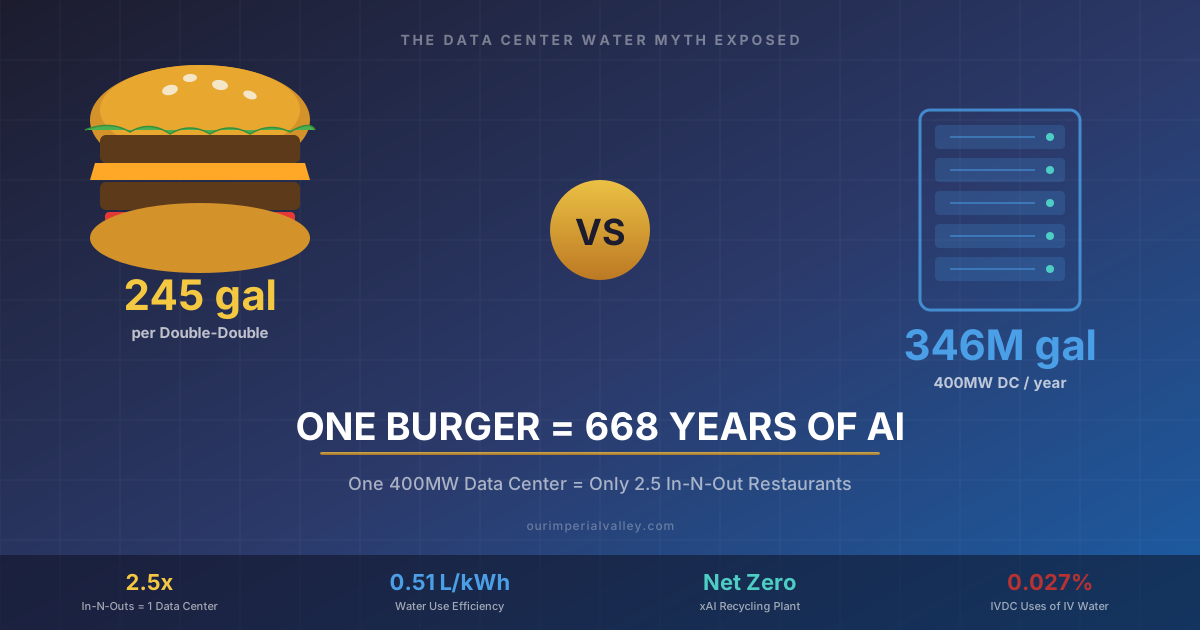
SemiAnalysis calculated the total blue-water footprint of xAI's Colossus 2 data center in Memphis, Tennessee — a 400-megawatt facility that is one of the largest AI data centers in the world. They compared it to the annual water consumption of an average In-N-Out Burger store.
Colossus 2's total annual water footprint: 346 million gallons. One average In-N-Out store (burgers only): 147 million gallons. That's a ratio of just 2.36 to 1.
One of the largest data centers on Earth uses the same water as 2.5 burger restaurants. There are over 400 In-N-Out locations in the United States alone — and hundreds of thousands of other burger joints.
The per-burger number is equally striking. SemiAnalysis broke down every ingredient of In-N-Out's Double-Double by blue-water intensity. The beef patties alone account for 95% of the water footprint, driven by irrigation for cattle feed crops. The result: 245 gallons of water per burger.
At 245 gallons per burger, the water footprint of a single Double-Double equals using Grok AI 30 times a day for 668 years. That is not a typo. One burger. 668 years of daily AI use.
How Modern Data Centers Use Water
The SemiAnalysis study reveals that data center water usage is far more nuanced than critics suggest. Not all "water consumption" is equal, and the cooling architecture matters enormously.
Colossus 2 uses a hybrid cooling system: approximately 130 dry coolers and 135 adiabatic cooling units. Dry coolers use virtually no water. Adiabatic units use a controlled water mist only during hot conditions — far less than traditional wet evaporative cooling. The facility achieves a Water Use Efficiency (WUE) of 0.51 liters per kilowatt-hour.
| Water Component | Annual Volume | % of Total |
|---|---|---|
| Cooling (evaporated) | 267 million gallons | 77% |
| Flush/blowdown (withdrawn, returned) | 66 million gallons | 19% |
| Chip manufacturing (amortized over 5 years) | 13 million gallons | 4% |
| Total annual water footprint | 346 million gallons | 100% |
Crucially, the 66 million gallons of flush/blowdown water is withdrawn but not consumed — it is returned to the water system. And xAI is already building a wastewater recycling plant that will recycle municipal wastewater from Memphis, potentially making Colossus 2 a net-zero water data center.
Now Apply This to Imperial Valley
The SemiAnalysis findings provide powerful national context for what the IVDC has been designed to do from day one.
Even xAI's Colossus — a facility that draws from the municipal water supply — uses only as much water as 2.5 In-N-Out restaurants. The Imperial Valley Data Center goes vastly further:
- Designed for recycled water — The IVDC was designed to run on recycled municipal wastewater rather than the Colorado River or groundwater. After the cities of Imperial and El Centro withdrew from that arrangement, the developer has had to seek a small river allotment as a last resort (about 0.03% of IID's entitlement). See our Salton Sea facts for the full current picture.
- Net water-positive by design — Under the original recycled-water plan, the facility would have processed roughly six times more water than it consumed and returned the surplus toward the Salton Sea.
- Up to 5.25 million gallons per day would have been returned to the Salton Sea under that plan — water that would otherwise be wasted.
If a 400MW data center using city tap water equals only 2.5 burger joints, what does that say about a data center designed to run on recycled wastewater and return millions of gallons daily to a dying inland sea? The IVDC's water footprint is not just defensible — by design it was meant to be a net environmental benefit.
What the Critics Won't Compare
NIMBY activists cite the IVDC's 750,000-gallon daily water use as an existential threat. They never put it in context. Here is the context:
| Metric | IVDC | One Farming Family | 2.5 In-N-Out Stores |
|---|---|---|---|
| Annual water | 273.75M gallons | 26.7 billion gallons | ~367M gallons |
| Water source | Designed for recycled wastewater | Colorado River | Municipal supply |
| Returns water? | By design — surplus to Salton Sea | No | No |
| Annual jobs | 1,688 construction + 100 permanent | Seasonal | ~125 total |
| Annual tax revenue | $28.75 million | A small fraction of the data center's | ~$375,000 |
A single farming family in Imperial Valley has been reported to use vastly more Colorado River water in a single year than the entire $10 billion data center would require — on the order of dozens of times as much. Nobody is filing lawsuits against them. Nobody is demanding they justify their water use.
The Real Water Conversation
Agriculture consumes 97% of IID's 3.1 million acre-feet of Colorado River water annually. The IVDC's full requirement is about 0.027%. The data center was designed around recycled water that would otherwise be wasted, treating and returning millions of gallons daily toward the Salton Sea. Even the river-water last resort the developer has had to seek since the cities withdrew amounts to roughly 0.03% of IID's entitlement. The project would generate $28.75 million per year in tax revenue while employing nearly 1,700 workers during construction.
Nobody demands that the 400+ In-N-Out restaurants across America account for the 147 million gallons each store consumes annually in embedded water. Nobody sues burger chains over water rights. But when a data center proposes to use recycled wastewater in the desert, it becomes a crisis.
The water argument against data centers is not data-driven. It is fear-driven. And the numbers — from SemiAnalysis nationally and from the IVDC's own environmental plan locally — prove it.
Sources: SemiAnalysis, "From Tokens to Burgers — A Water Footprint Face-Off" (March 2026); Rotz et al., "Environmental footprint of beef cattle production in 18 U.S. regions" (2019); SemiAnalysis Datacenter Industry Model; IID annual water allocation records; IVCM Environmental Impact Assessment; USGS water use data.