The most emotionally charged argument against the Imperial Valley Data Center is water. Critics from groups like NIMBY Imperial and Valle Imperial Resiste consistently portray the facility's water needs as a catastrophic drain on a fragile desert ecosystem. Francisco Leal, Anahi Araiza, and allied activists cite the figure of 750,000 gallons per day as though it represents an existential threat to the region.
It does not. When subjected to even basic comparative analysis, the water argument collapses entirely.
The Numbers That Matter
The Imperial Irrigation District holds senior water rights to 3.1 million acre-feet of Colorado River water annually — over 70% of California's entire legal entitlement from the river system. One acre-foot equals 325,853 gallons. That means IID's total annual water portfolio is roughly 1.01 trillion gallons.
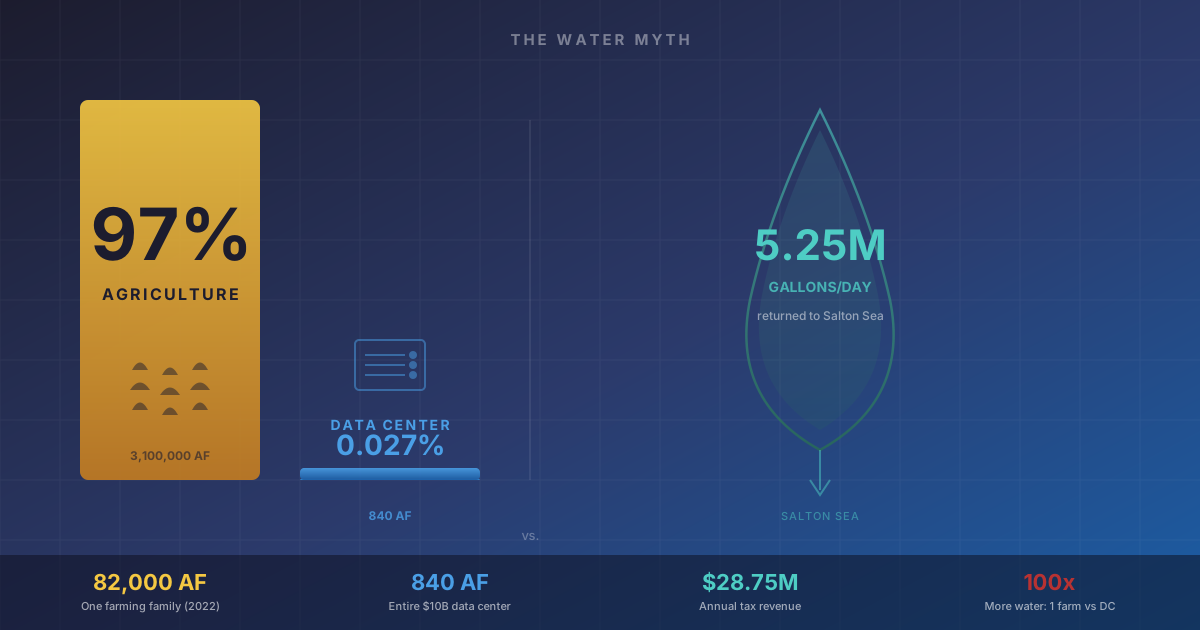
The data center's maximum daily requirement of 750,000 gallons equates to 273.75 million gallons per year, or approximately 840 acre-feet.
840 acre-feet out of 3,100,000 acre-feet = 0.027% of the Imperial Valley's annual water supply.
IID already maintains a dedicated, pre-existing set-aside of 25,000 acre-feet specifically reserved for industrial use. To date, only 1,200 acre-feet of that allotment has been allocated. The IVDC fits comfortably within a microscopic fraction of this existing, unused industrial surplus.
The Alfalfa Comparison
The hypocrisy of the water argument becomes obvious when you compare the data center to the valley's dominant agricultural output: alfalfa. Alfalfa is a water-intensive forage crop used primarily for livestock feed, much of which is exported out of the region entirely. It requires massive amounts of flood irrigation to survive the desert heat.
| Metric | Alfalfa (75 Acres) | Data Center (75 Acres) |
|---|---|---|
| Annual Water Usage | 375 to 487 acre-feet | ~840 acre-feet |
| Total Gallons | ~122M to ~159M gallons | ~273.75M gallons |
| Economic Yield | ~$300/acre-foot | Tens of millions in tax revenue; $10B capital asset |
| Water Cost to Operator | ~$20/acre-foot (subsidized) | $80/acre-foot (industrial rate) |
| Water Source | Colorado River (fresh) | Designed for recycled wastewater |
| Annual Tax Revenue | A tiny fraction of the data center's | $28.75 million |
Yes, the data center uses roughly double the water of a geographically equivalent 75-acre alfalfa field. But its economic output per drop of water is astronomically higher. Agriculture consumes nearly 97% of the region's water while generating only about 16% of the county's employment.
One Family vs. the Entire Data Center
For the most striking comparison, consider this: public records indicate that a single farming family in the Imperial Valley utilized an estimated 82,000 acre-feet of water in 2022 to sustain their operations. That is nearly one hundred times the water required by the entire proposed $10 billion data center.
82,000 acre-feet (one farming family) vs. 840 acre-feet (a $10 billion data center that creates 1,688 jobs and generates $28.75 million in annual tax revenue). Which represents a more efficient use of the valley's most precious resource?
Closed-Loop Cooling: Not Your Grandfather's Data Center
Modern hyperscale data centers do not consume and dump water. They utilize advanced, closed-loop cooling systems where water is continuously recycled. The IVDC's water plan was designed to go further: to purchase reclaimed municipal wastewater — water that cities currently struggle to dispose of — and use a fraction for cooling. Under that plan, the rest would be treated and released into the Salton Sea.
The facility was designed not to compete with farms, draw from the Colorado River, or touch groundwater or potable supply — using water that would otherwise be wasted and returning far more than it consumes. After the cities of Imperial and El Centro withdrew from the recycled-water arrangement, the developer has had to seek a small Colorado River allotment as a documented last resort: roughly 880 acre-feet, about 0.03% of IID's 3.1 million acre-foot entitlement and less than the 160-acre farm that parcel would replace. See our Salton Sea facts page for the current picture.
The Sabotage of the Reclaimed Water Initiative
Perhaps most damning is what happened when the developer tried to secure this recycled water. Sebastian Rucci, the developer, proposed to purchase up to roughly 6 million gallons of reclaimed water daily from El Centro and Imperial under the plan he put forward. The developer committed to paying for infrastructure upgrades — millions of dollars in treatment-plant improvements and to pay for the water itself.
Under that proposal the data center would have consumed only about one-eighth of this water (750,000 gallons). The developer said the remaining roughly 5.25 million gallons of newly treated water would have been released daily into the drying Salton Sea.
Rather than championing this private-sector environmental solution, the City of Imperial obstructed it. The federal civil rights lawsuit alleges that city officials actively pressured El Centro to terminate the conditional water supply agreement — weaponizing inter-municipal relationships to choke off the project.
With the cities having backed out of the recycled-water arrangement, the developer has had to turn to a small Colorado River allotment as a last resort — the very outcome critics now point to. NIMBY activists who claim to protect the valley's water are simultaneously cheering the collapse of a privately funded plan that would have actively restored the Salton Sea.
Statistical Illiteracy Is Not an Environmental Policy
The water argument against the IVDC is not merely wrong. It is the mathematical equivalent of complaining about a dripping faucet while ignoring an open fire hydrant. Agriculture consumes 97% of the valley's water portfolio. The data center needs 0.027%. The developer offered to pay a premium for recycled wastewater that nobody else wants, upgrade the treatment infrastructure at their own expense, and send millions of gallons to restore the Salton Sea.
Rejecting this project on water grounds is not environmental protection. It is economic sabotage dressed up in green.
Sources: Imperial Irrigation District water allocation data, California Employment Development Department, IID industrial rate schedules, IVCM Environmental Plan, University of California Cooperative Extension alfalfa irrigation research, Imperial County ACFR 2022-2023. Full citations available upon request.