In the desert, water is everything. The Imperial Valley holds senior rights to over 70% of California's total legal entitlement from the Colorado River — a resource that fuels the region's massive agricultural output and sustains its communities. So when a $10 billion data center was proposed, the first question was obvious: where does the water come from?
The answer is one of the most innovative water strategies any private developer has ever proposed in California: the facility was designed to run on recycled municipal wastewater rather than the Colorado River. That original recycled-water plan collapsed when the cities of Imperial and El Centro backed out of the arrangement, and the developer has since had to seek a small Colorado River allotment as a documented "last resort." For the full current picture, see our Salton Sea facts page.
The "Net Water-Positive" Design
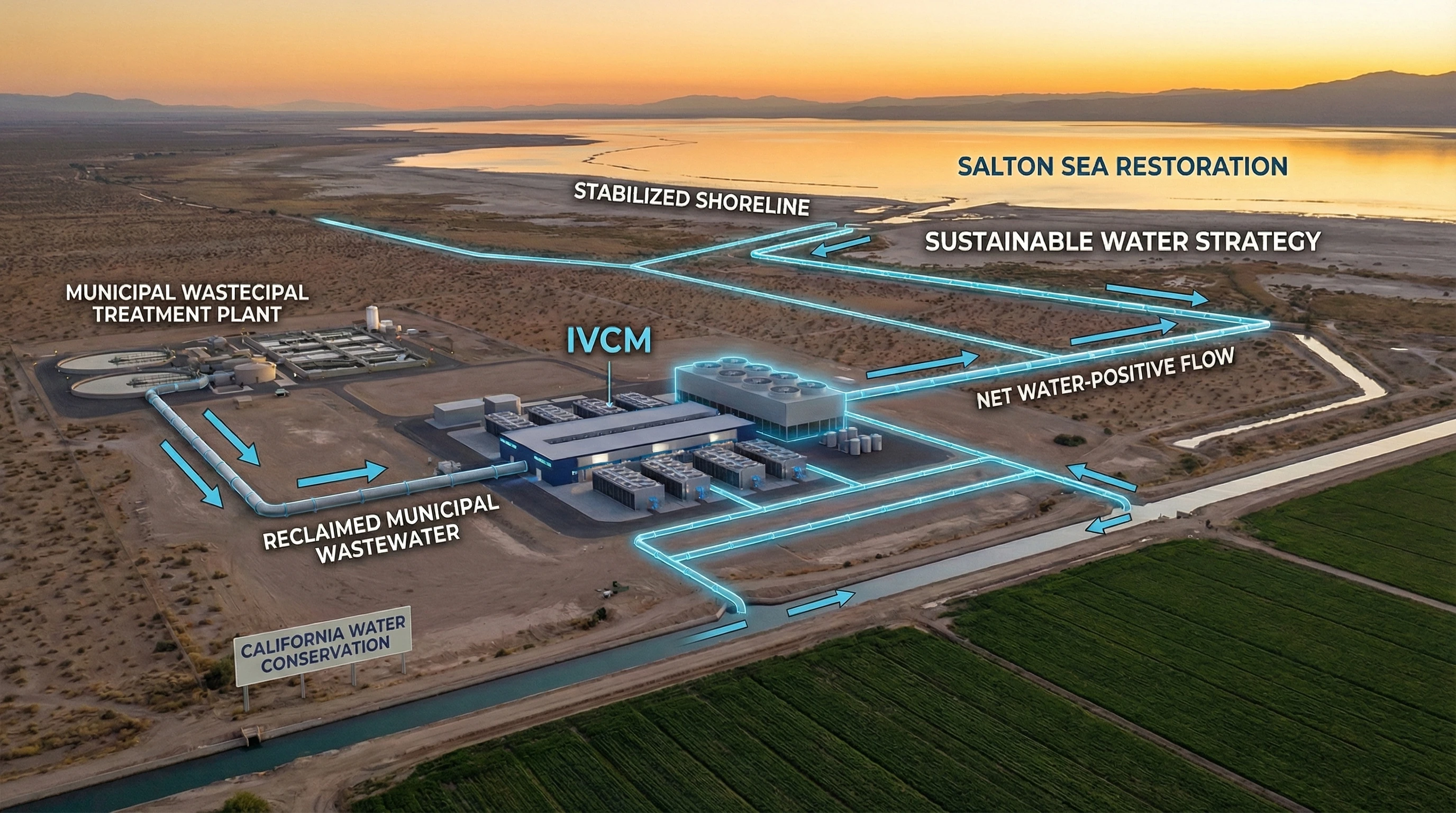
The IVCM data center's original water plan was built on a simple but powerful concept: use recycled water that would otherwise go to waste, and return more than you take.
Here is how it was designed to work:
Under the original recycled-water plan, the facility would have processed far more water than it consumed — on the order of six times as much — returning the cleaned surplus toward the Salton Sea. By design, this was not a data center that would take from the community's water supply. It was designed to give back to the community's most urgent environmental priority. That plan depended on the participating cities, who later withdrew (see below).
Why the Salton Sea Needs This
The Salton Sea is California's largest lake — and one of its most severe environmental disasters. It relies heavily on agricultural runoff to maintain its water levels. As conservation efforts increase and runoff decreases, the Sea has been rapidly drying, exposing thousands of acres of toxic, pesticide-laden playa to brutal desert winds.
The consequences are devastating and immediate:
- Toxic dust plumes carry heavy metals and agricultural chemicals across the Valley
- Asthma and respiratory illness rates in surrounding communities — predominantly Latino — are among the highest in California
- Wildlife habitat for over 400 species of migratory birds continues to collapse
- State and federal restoration efforts have been chronically underfunded and behind schedule
By releasing millions of gallons of treated water into the Salton Sea daily, the IVDC was designed to increase net inflow, help stabilize the shrinking shoreline, and suppress the toxic dust that threatens children's respiratory health. All at zero cost to the taxpayer.
What the IVDC Water Plan Was Designed To Do
Critics have circulated the narrative that the data center will drain local water supplies, forcing technology companies to compete with farms and drinking water. The design tells a more careful story. Let's be specific:
| Claim | The Design |
|---|---|
| "It will drain the Colorado River" | The facility was designed to run on recycled municipal wastewater, not the Colorado River or groundwater. After the cities withdrew, the developer has sought roughly 880 acre-feet of river water as a last resort — about 0.03% of IID's 3.1 million acre-foot entitlement, less than the 160-acre farm that parcel would replace. |
| "It competes with agriculture" | The plan was built around municipal wastewater that would otherwise be discarded — not agricultural deliveries. |
| "It will lower water pressure for residents" | The design uses no potable water. Residential supply is unaffected. |
| "Data centers waste water" | Under the original recycled-water plan, the facility would have treated far more water than it consumed and returned the surplus to the Salton Sea — a net positive for the region. |
The Gold Standard for Environmental Stewardship
Consider the full environmental profile of the IVDC:
- Water: designed around recycled municipal wastewater — net water-positive by design
- Power: IID's grid runs on geothermal and solar — among the cleanest in California
- Storage: 862 MWh Tesla BESS that actively stabilizes the grid
- Infrastructure: Developer-funded 330 MW substation — no ratepayer cost
- Land: Industrial-zoned parcel — not farmland, not habitat, not residential
This is a scenario where the private sector uses its capital to address a public crisis at no cost to the taxpayer. If this project cannot satisfy environmental standards, nothing can.
The Obstruction Hurts the Environment
Here is the irony: the entities claiming environmental concern are the ones who walked away from the plan that would have helped the Salton Sea. The cities of Imperial and El Centro backed out of the recycled-water arrangement, and reports indicate the City of Imperial pressured neighboring municipalities to terminate conditional "will-serve" letters for water supply. With its designed recycled-water source gone, the developer has had to seek a small Colorado River allotment as a last resort.
Obstructing this project does not save Imperial Valley's water. It denies the Salton Sea a vital, privately funded lifeline. Every month the IVDC sits in litigation is another month of toxic dust blowing across the Valley, another month of children breathing contaminated air, another month of a shrinking lake that no one else is funding to restore.
To protect our air quality, preserve our Colorado River allotments for agriculture, and stabilize the Salton Sea, residents must demand that municipal leaders halt their campaign of administrative obstruction and restore the recycled-water arrangement that made the IVDC's net water-positive design possible in the first place.
Sources: IVCM Environmental Plan, Imperial County Board of Supervisors records, California Natural Resources Agency Salton Sea Management Program, IID water transfer data. Full citations available upon request.