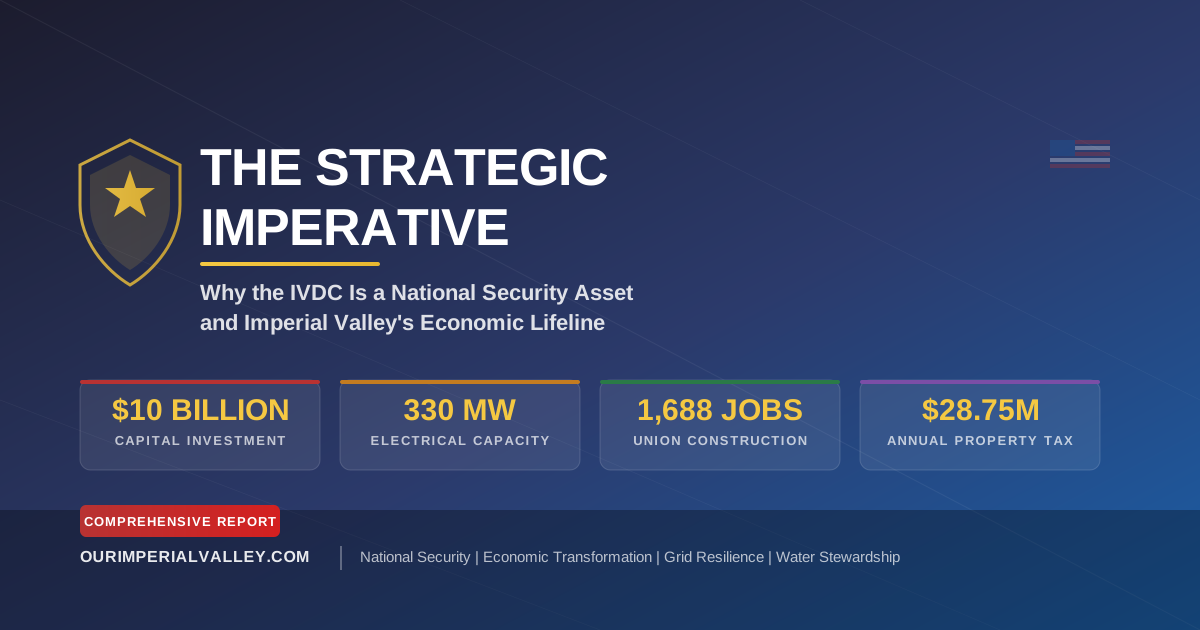
The global economy is undergoing a fundamental restructuring driven by the rapid acceleration of artificial intelligence. At the center of this transformation is a single, unavoidable fact: the nation that builds the most advanced computing infrastructure wins. The United States is locked in what policymakers and defense strategists openly call an "AI Arms Race" with China — and the speed at which hyperscale data centers can be deployed is a critical determinant of who prevails.
Within this context, the proposed $10 billion Imperial Valley Data Center (IVDC) is not merely an economic development project for a struggling rural county. It is a strategic national asset — a 950,000-square-foot advanced digital manufacturing campus engineered to serve the compute-intensive demands of the world's largest technology companies, positioned on industrially zoned land adjacent to major high-voltage transmission corridors.
Yet despite its overwhelming economic logic and strategic necessity, the IVDC faces aggressive, coordinated resistance. A rigorous, evidence-based analysis reveals that the opposition relies on fundamental misrepresentations of utility economics, debunked water myths, and a documented pattern of regulatory weaponization designed to extract financial settlements under the guise of environmental protection.
National Security
A strategic asset in the AI arms race — every month of delay hands advantage to America's adversaries
Grid Resilience
Interruptible service + 862 MWh battery = a shock absorber that strengthens the power grid
Water Stewardship
Designed to run on recycled wastewater and to minimize Colorado River use — with surplus intended to help restore the Salton Sea
The AI Arms Race: Why Speed Matters
The United States and China are competing for dominance in advanced computational capabilities. The speed at which hyperscale computing infrastructure can be deployed is a critical determinant of geopolitical success.
Domestic deployment of AI infrastructure is frequently throttled by protracted regulatory delays — particularly in states like California — forcing critical computing capacity to either languish in administrative purgatory or migrate to foreign jurisdictions.
The IVDC is designed to carry a massive 330-megawatt electrical load, supported by an integrated 862-megawatt-hour battery energy storage system — the largest battery deployment ever paired with an American data center. This positions it as one of the largest data centers in California by both electrical capacity and physical footprint.
⚠ The Threat
China is building hyperscale AI infrastructure at breakneck speed while California's regulatory system delays American projects for years. Every month of obstruction is a month of lost geopolitical advantage.
✓ The Opportunity
Imperial County has industrially zoned land, high-voltage transmission corridors, and a workforce desperate for opportunity. The IVDC can be deployed rapidly on land the county's zoning code already designated for exactly this use.
Blocking or delaying this facility does not protect the community. It hands a strategic advantage to America's adversaries.
Generational Wealth for Imperial County
Imperial County consistently ranks among the highest-unemployment counties in the United States. The IVDC represents the single largest private capital investment in the county's history.
The local economy relies disproportionately on agriculture — an industry highly vulnerable to climate fluctuations, Colorado River water rationing, and global commodity price volatility. The introduction of a $10 billion advanced manufacturing campus provides a fundamentally transformative mechanism for regional economic diversification.
| Economic Impact | Value |
|---|---|
| Total Capital Investment | $10,000,000,000 |
| Direct Construction Employment | 1,688 Union Jobs (2-year phase) |
| Permanent Tech Operations | 100 High-Skill Positions |
| One-Time Sales Tax Revenue | $72,500,000 |
| Recurring Annual Property Tax | $28,750,000 |
| Personal Property Taxes | $10,000,000 Annually |
| Utility Net Revenue (IID) | Up to $30,000,000 Annually |
| Increase in Assessed Value | ~$9,000,000,000 added to County |
During the estimated two-year construction phase, the project is projected to create 1,688 direct union construction jobs. By mandating union labor, the project ensures capital expenditure translates directly into localized wage growth, healthcare benefits, and pension contributions for working-class families.
The injection of $72.5 million in one-time sales tax during construction provides an immediate, massive cash infusion into local government. The nearly $28.75 million in recurring annual property taxes represents a permanent paradigm shift — funds flowing directly into public schools, fire departments, police departments, and civic infrastructure.
The Rate Hike Myth: Demolished by Engineering and Economics
Critics claim the IVDC's 330 MW load will raise residential electricity bills. The engineering, regulatory, and economic evidence proves the exact opposite.
"The data center will raise our electric bills. Residential ratepayers will be forced to subsidize the IVDC's massive power infrastructure."
The "cost causation" principle requires the developer — not ratepayers — to pay for all substations, transmission lines, and system upgrades. The IVDC generates up to $30 million/year in net utility revenue.
The facts are clear:
- Cost causation principle: Regulatory frameworks governing utilities like the IID dictate that infrastructure costs triggered by a new industrial customer must be borne entirely by that customer — not distributed across the residential rate base.
- Developer pays for everything: The developer finances all specific substations, transmission lines, heavy-duty transformers, and localized upgrades. If the data center closes, ratepayers are not left paying off the debt.
- $30 million in net annual utility revenue: This capital improves the IID's Debt Service Coverage Ratio and bolsters Days Cash on Hand — metrics that secure favorable credit ratings and reduce the utility's overall cost of debt. Lower cost of debt inherently stabilizes or lowers rates for all customers.
A political campaign vowing to "protect ratepayers" by opposing the IVDC achieves the exact opposite of its stated goal. By obstructing a project capable of delivering $30 million in net annual utility revenue, critics condemn residents to the very rate hikes they claim to fear.
Grid Resilience: The Interruptible Service Paradigm
The IVDC is not designed to be a parasitic drain on the local grid — it is engineered to be a dynamic grid asset that actively strengthens power infrastructure.
The most critical technological safeguard is the IVDC's explicit commitment to operate under an "interruptible service" agreement. Under traditional firm-power contracts, utilities must deliver uninterrupted electricity regardless of grid conditions. The IVDC operates under a fundamentally different paradigm:
Utility is legally obligated to deliver uninterrupted electricity to industrial facilities regardless of grid conditions — forcing utilities to scramble for peaker-plant power during emergencies.
IID has absolute contractual authority to curtail, throttle, or completely sever power delivery during grid emergencies. Residents always come first.
When the IID issues a curtailment order during a grid emergency, the IVDC does not simply shut down — it seamlessly islands itself from the macro-grid and transitions to its localized 862 MWh battery energy storage system and 100 natural gas-powered backup generators. This advanced microgrid architecture effectively removes 330 MW of demand from the regional network instantaneously — acting as a massive relief valve for the power network.
The S-Line: A $40 Million Upgrade That Benefits Everyone
The S-Line transmission corridor upgrade demonstrates a development model that aggressively prioritizes socioeconomic equity and low-income ratepayer assistance.
The Imperial Irrigation District partnered with Citizens Energy Corporation to execute a $40 million upgrade of the existing 18-mile S-Line transmission corridor — transforming a legacy single-circuit wooden pole structure into a state-of-the-art, double-circuit steel tower transmission line.
Citizens Energy, founded in 1979 by former U.S. Congressman Joseph P. Kennedy II, operates under a unique non-profit model. In exchange for financing the S-Line, the organization committed to channeling 50% of its annual profits directly into energy assistance programs for low-income ratepayers in the Imperial Valley.
This is not theoretical. Citizens Energy previously utilized profits from other regional projects, such as the Sunrise Powerlink, to fully fund and construct the nation's largest low-income community solar project — a 30-megawatt solar array near Calipatria that currently provides subsidized electricity to 12,000 low-income households in the Imperial and Coachella valleys.
The Purple Pipe: Designed to Run on Recycled Water
The IVDC is designed to run on recycled municipal wastewater rather than the community's drinking water, minimizing demand on Colorado River supplies.
"The data center will drain 750,000 gallons per day from our water supply, depleting aquifers and causing residential water rationing."
The IVDC is designed to avoid potable water. Its closed-loop "purple pipe" system is built to run on recycled municipal wastewater — water currently being discharged unused into agricultural drains. After the cities of Imperial and El Centro withdrew from the recycled-water arrangement, the developer has sought a limited Colorado River allocation as a last resort.
- Treatment-plant upgrades the developer offered to fund: Under the original recycled-water proposal, the developer offered to invest millions of dollars in local municipal water plant infrastructure and to pay for the reclaimed, non-potable water it would purchase.
- Recycled-water design: Under the original recycled-water plan, the on-site facilities would have processed far more wastewater than the data center consumes through evaporation, returning the surplus toward the Salton Sea.
- Salton Sea restoration: Surplus clean, treated water is intended to flow into the local watershed — designed to contribute to ecological restoration of the collapsing Salton Sea ecosystem.
The data center was designed to draw on recycled municipal wastewater rather than the community's drinking water. As designed, the IVDC functions as a privately funded water filtration plant that remediates municipal wastewater and is intended to direct surplus toward the Salton Sea basin.
The Pattern of Obstruction
The opposition to the IVDC is not about environmental protection. It is a documented pattern of regulatory weaponization and financial extraction.
The developers intentionally located the project on land already zoned for heavy industrial use. Because the land was preemptively designated for industrial activity, the project legally qualified for "ministerial" approval — a by-right permit the county is legally obligated to issue.
Despite this:
- The City of Imperial filed a hostile lawsuit demanding discretionary CEQA review — the Superior Court found the city's arguments legally insufficient.
- State Senator Steve Padilla introduced SB 886 and SB 887 — legislation transparently targeting the IVDC to retroactively strip data centers of ministerial rights.
- Environmental groups demanded $83 million to drop their opposition — exposing the real financial motivation behind the obstruction campaign.
Securing the Digital Future
As the geopolitical race for AI dominance accelerates, the United States must rapidly deploy secure, hyperscale computing infrastructure. Imperial County possesses all the necessary attributes: unique geographic positioning, available industrial land, and proximity to major high-voltage electrical transmission corridors.
A rigorous, evidence-based assessment completely dismantles every core argument against the IVDC:
To block this development through bad-faith administrative obstruction is to condemn the Imperial Valley to continued, managed economic decline while simultaneously undermining the broader technological competitiveness of the United States.
The Facts Are Clear. The Stakes Are National.
Every month of delay is a month of lost jobs, lost tax revenue, and lost ground in the AI arms race.
Read the Facts Support the ProjectSources: Brookings Institution, KPBS investigative reporting, Imperial County Planning Department records, IID public information initiative, federal court filings (Case 3:26-cv-00128-JLS-BJW), Calexico Chronicle, Citizens Energy Corporation, Cleanview energy data, California Government Code § 65850 et seq., CEQA Guidelines § 15268, Dominion Energy 2024 earnings reports, PG&E load modeling data, Entergy Mississippi grid reliability reports. Full citations available upon request.