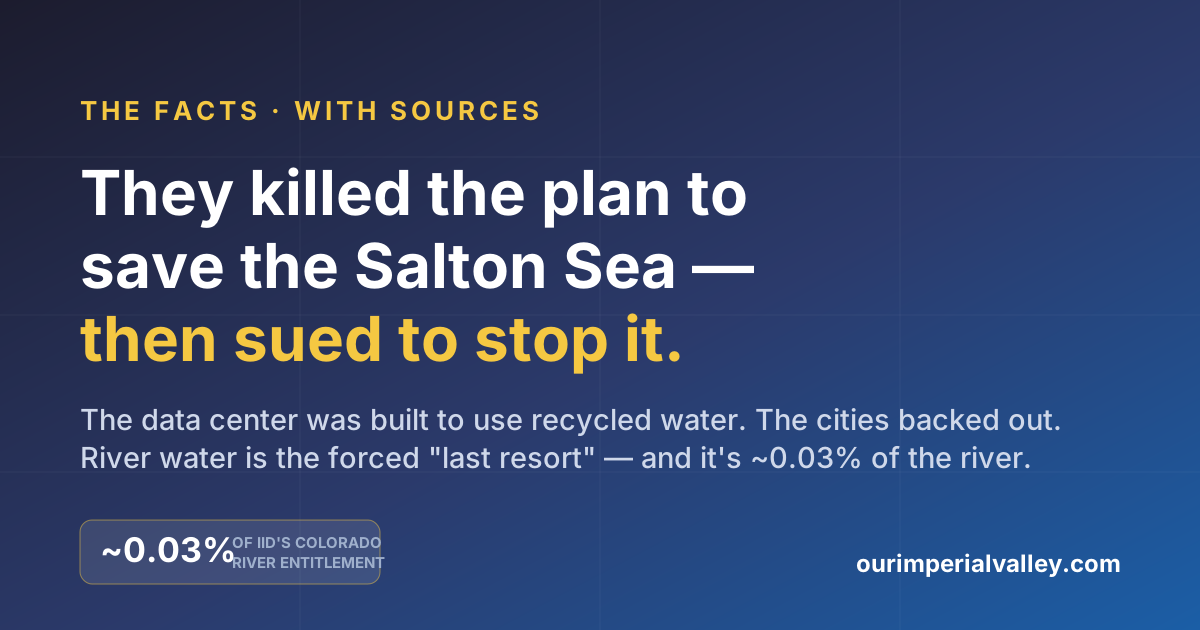
The story you have heard is simple: a developer promised the data center would not take "a single drop" of Colorado River water, and now he is in court asking for river water. Framed that way, it sounds like a broken promise. But the framing leaves out the most important part — the part where local officials killed the clean-water plan that made the promise possible in the first place.
Here is the documented record. Every claim below is sourced, and where something is a legal allegation, we say so.
The plan: recycled water, and a lifeline for the Salton Sea
The Imperial Valley Data Center was engineered to run on recycled municipal wastewater — not the river, and not farmers' irrigation water. Under the plan, the developer agreed to fund upgrades to the cities' treatment plants, pay for the water, and route the cleaned surplus toward the dying Salton Sea, whose receding shoreline exposes toxic dust that drives the valley's asthma crisis. In other words, the project was designed to put clean water back into the region, not drain it.
The betrayal: the cities backed out
Then the cities of Imperial and El Centro withdrew from the arrangement. With recycled water no longer available, the company had to find another source. It turned to the Imperial Irrigation District and, when that application was denied, went to court — describing the river-water request in its own lawsuit as a "last resort." (Source: KPBS, June 15, 2026.)
The water math nobody puts in the headline
The amount in dispute is about 880 acre-feet a year. The Imperial Irrigation District holds rights to 3.1 million acre-feet — the single largest entitlement on the Colorado River. That makes the request roughly 0.03% of the district's water, and less than the 160-acre farm the project would replace (alfalfa alone uses about 5–6.5 acre-feet per acre). The developer's plan to offset its use by fallowing that farm is a legal argument now being litigated — not a settled fact, but also not the catastrophe the headlines imply.
Your power bill is not the casualty here
A second fear — that the data center will spike residential electricity rates — runs into the district's own rules. IID's proposed Large Load Tariff requires very large customers to fund their own grid upgrades, so the cost falls on the developer, not on families. The project also adds an 862 MWh battery and runs on interruptible power, meaning it can be cut from the grid first during a heat wave. The real pressure on local bills is IID's own maintenance backlog and rate increases — pressures that new revenue from a large customer helps offset, not worsen.
The contradiction at the county
In the same meeting where county supervisors moved to pause data center development, they also moved to extend five local states of emergency — including three structurally failing bridges. You cannot declare a bridge emergency and, in the same breath, pause the largest private investment and tax base that could help pay to fix it.
The honest bottom line
None of this means the project is above scrutiny. It means the loudest claim against it — that a liar is draining the river — skips the documented sequence: a plan built to use recycled water and help the Salton Sea, a withdrawal by the cities, and a small "last resort" request that amounts to a rounding error in the district's supply. Before repeating the headline, it is worth asking who actually killed the clean-water plan.
See the full record, with charts and sources: The Salton Sea Betrayal — Water Facts →