The Imperial Valley Data Center (IVDC) is the single largest private investment ever proposed in Imperial County — a $10 billion, 950,000-square-foot artificial intelligence and cloud computing facility on 74 acres of heavy industrial land at the corner of Aten Road and Clark Road in unincorporated Imperial County.
Developed by Imperial Valley Computer Manufacturing (IVCM), the facility would deliver 330 megawatts of computing capacity for one of the world's largest technology companies, positioning Imperial Valley as a critical node in America's AI infrastructure.
Here is what the project entails — the engineering, the economics, and the facts.
The Numbers
| Metric | Value |
|---|---|
| Total Private Investment | $10 billion |
| Facility Size | 950,000 sq ft on 74 acres |
| Power Capacity | 330 MW |
| Construction Jobs | 1,688 union positions at prevailing wages |
| Permanent Tech Jobs | 100+ network engineering & facility management |
| Annual IID Revenue | Up to $30 million/year (cost-plus wholesale model) |
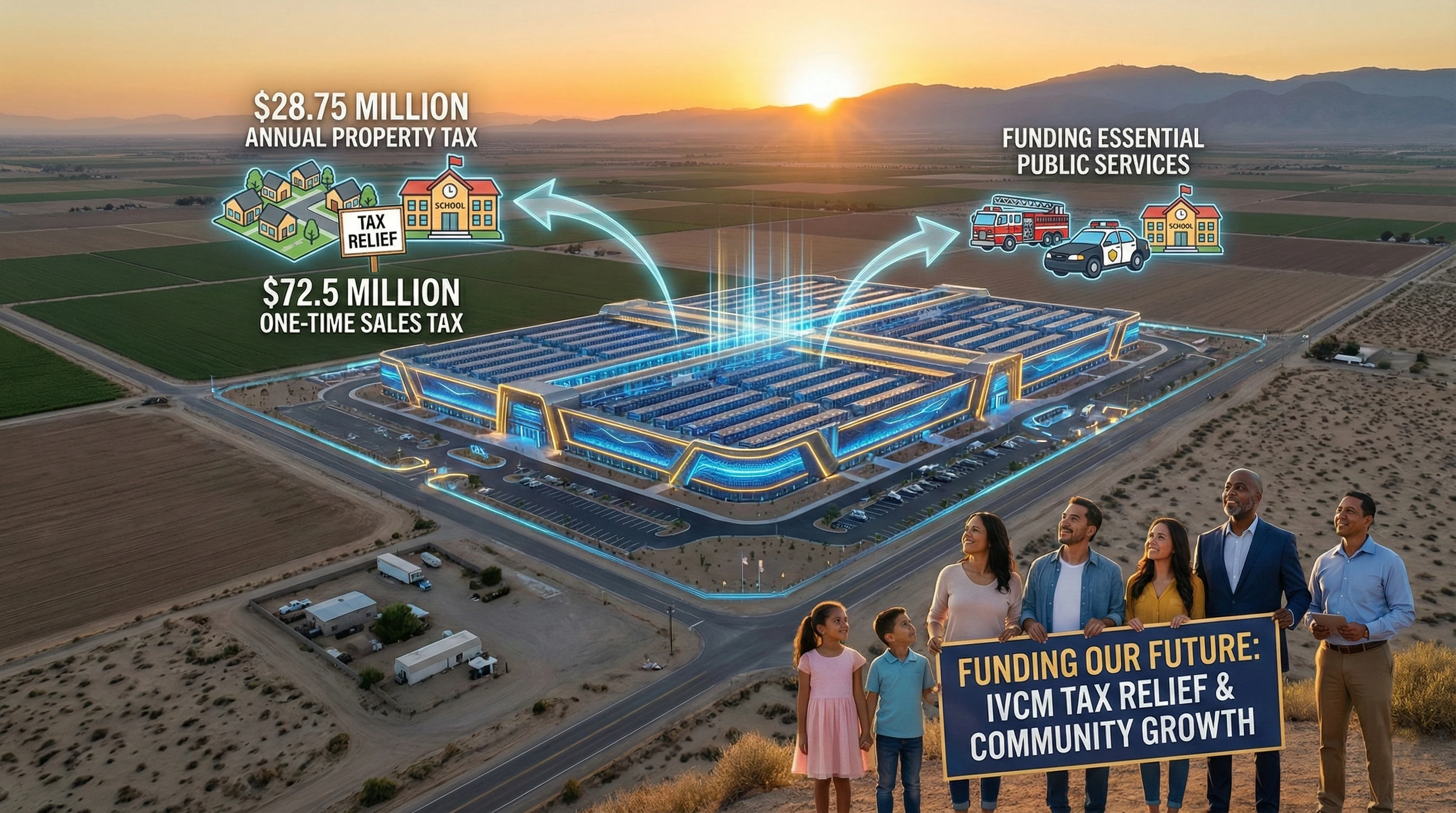
| Annual Property Tax | $28.75 million (schools, fire, police, infrastructure) |
| One-Time Sales Tax | $72.5 million |
| Energy Storage | 220 Tesla Megapacks (862 MWh) |
| Potable Water Use | Designed for recycled wastewater; river as a last resort |
Legally Confirmed: By-Right Development on Industrial Land
The IVDC sits on I-2 heavy industrial zoned land where data centers are a permitted use under Imperial County Code sections 90515.01 and 90516.01. This is not a creative interpretation of the zoning code — it is the textbook application of ministerial permitting, the same process used for warehouses, manufacturing plants, and other industrial facilities across California.
The courts have agreed. Twice.
February 27, 2026 — Superior Court Ruling
A Superior Court judge dismissed the City of Imperial's 35-page, 121-paragraph lawsuit, ruling the data center is a "by-rights" permissible use and the complaint was "legally insufficient to state a cause of action."
April 2, 2026 — Emergency Halt Denied
Judge Anderholt denied the City of Imperial's emergency request to halt the Board of Supervisors' lot merger vote.
Grid Reliability: A Shock Absorber, Not a Drain
One of the most persistent misconceptions about the IVDC is that it threatens grid stability. The engineering reality is the opposite.
The facility deploys 220 Tesla Megapack 2XL units providing 862 MWh of battery storage with grid-forming inverters. Under an interruptible service contract, IID can cut the center's power instantly during grid emergencies. The facility then islands itself from the macro-grid, removing 330 MW of demand — functioning as a shock absorber that strengthens grid resilience for every IID customer.
This is not theoretical. This is how interruptible industrial loads have functioned on utility grids for decades. The IVDC simply does it at scale, with the largest battery energy storage system ever deployed at an American data center.
Water: Designed for Recycled Water (river a last resort)
The IVDC was designed to run on recycled municipal wastewater via a closed-loop "purple pipe" system. Under that original plan, the developer would have purchased millions of gallons of reclaimed water daily, used only a small fraction for cooling, and returned the cleaned surplus to the Salton Sea watershed — helping suppress the toxic dust that plagues valley communities as the sea recedes. After the cities backed out, a small river-water request (~0.03% of IID's entitlement, less than the farm it replaces) became a documented last resort.
For scale: IID holds 3.1 million acre-feet in senior water rights. A single Imperial Valley farming family used an estimated 82,000 acre-feet of Colorado River water in 2022 — nearly 100 times the data center's entire annual need of 840 acre-feet. The water myth has been thoroughly debunked.
The Revenue Model: How the Data Center Lowers Your Rates
The $30 million in annual IID revenue comes from a cost-plus wholesale electricity model. The developer pays IID for power at rates that cover all generation, transmission, and distribution costs — plus a profit margin. This is pure revenue that IID can use to reduce the rate burden on residential customers who are already absorbing the historic 69% rate hike.
Under cost causation principles, the developer is strictly responsible for financing all infrastructure upgrades — substations, transmission lines, transformers, and localized grid improvements. Existing ratepayers pay nothing. The developer also offered millions to upgrade municipal wastewater treatment plants.
$10 billion in private investment. 1,688 union jobs. $30 million a year for IID. Designed to run on recycled water. The project has been court-confirmed twice. The only obstacle remaining is political will.
Sources: Imperial County Superior Court (February 27, 2026 ruling; April 2, 2026 ruling), Imperial County Planning Department records, IVCM project specifications, IID rate filings, USDA Census of Agriculture (2022).