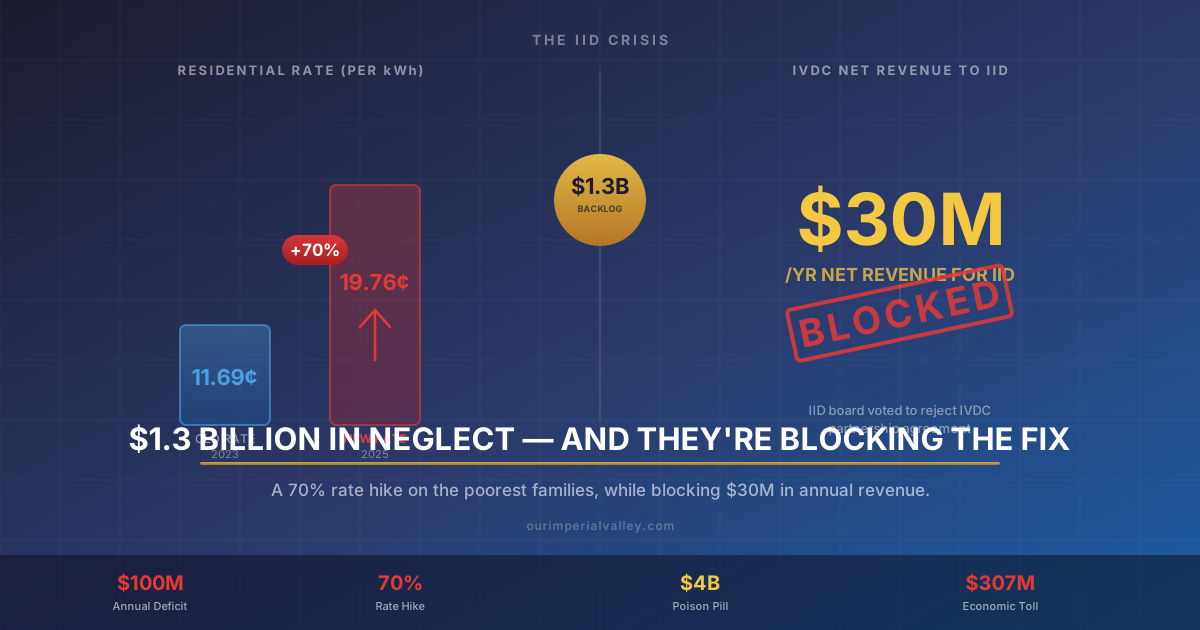
The Imperial Irrigation District is in crisis. After decades of institutional mismanagement, deferred maintenance, and strategic negligence, the IID now faces a $1.3 billion maintenance backlog for aging infrastructure and a $100 million annual structural deficit. Its reserves have been drained. Its grid is deteriorating. And its solution to this self-inflicted catastrophe is breathtaking in its cruelty: a nearly 70% rate hike on the base electricity rate — imposed on families in a county with an 18.6% unemployment rate and a $56,000 median household income.
Meanwhile, sitting on the table is a fully financed, shovel-ready project that would generate $30 million a year in net revenue for the district — revenue that could service the maintenance backlog, bolster depleted reserves, and apply genuine downward pressure on residential rates. The IID Board's response? A $4 billion "poison pill" demand designed to kill the project dead.
This is the story of an institution that would rather tax poverty than reform itself.
The Institutional Crisis
The IID's current predicament did not materialize overnight. It is the product of decades of institutional mismanagement, poor strategic planning, and a historical pattern of decision-making that consistently prioritized politically connected interests over ratepayer welfare.
For years, the IID granted favored, politically connected energy developers access to its grid without requiring them to pay for the necessary infrastructure upgrades their projects demanded. New generation facilities were interconnected. New transmission loads were added. And the cost of reinforcing, upgrading, and maintaining the grid to handle those loads was quietly shifted — not to the developers who caused them, but to residential ratepayers.
The result is a utility district sitting on top of a $1.3 billion mountain of deferred maintenance. Aging transmission lines. Deteriorating substations. Overloaded transformers. Infrastructure that should have been upgraded decades ago was allowed to decay while the district's reserves were systematically drained. The $100 million annual structural deficit is not a surprise — it is the entirely predictable consequence of an institution that spent decades avoiding hard choices and letting connected insiders socialize their costs onto working families.
This is not a funding problem. It is an accountability problem.
The Rate Hike: A Tax on Poverty
Faced with the bill for its own institutional failure, the IID Board chose the path of least political resistance: it raised rates on the people least equipped to fight back.
The base electricity rate was increased from 11.69 cents to 19.76 cents per kilowatt-hour — a nearly 70% increase. In any context, a rate hike of this magnitude would be punishing. In Imperial County, it is devastating.
This is a county where 18.6% of the workforce is unemployed — roughly triple the national average. The median household income is $56,000, well below the California median of over $90,000. Many families are already choosing between groceries and air conditioning in a desert region where summer temperatures routinely exceed 115 degrees Fahrenheit. Electricity is not a luxury here. It is survival.
A 70% rate hike in this context functions as a highly regressive direct tax on poverty. It falls hardest on the families who can least afford it — the single mothers working two jobs in El Centro, the agricultural laborers in Westmoreland, the retired couples on fixed incomes across the Valley. These are the people now being asked to shoulder the financial burden of decades of institutional failure they had no hand in creating.
The $4 Billion Poison Pill
If the rate hike reveals the IID Board's willingness to punish ratepayers for its own failures, the Board's treatment of the Imperial Valley Data Center reveals something worse: a deliberate strategy to block the single largest source of new revenue the district has ever been offered.
The IID Board demanded a $4 billion upfront prepayment from the IVDC developer as a condition for interconnection — a sum that exceeds the assessed value of IID's entire existing infrastructure and represents an unprecedented financial barrier that no rational energy developer could accept.
Reform IID Now, the ratepayer advocacy organization, has characterized this demand for exactly what it is:
A financial poison pill. The $4 billion demand is not a good-faith negotiating position. It is a calculated, bad-faith maneuver designed to kill a $10 billion project that would generate $30 million a year in net revenue for the district. It protects the institutional status quo — and ensures that ratepayers keep footing the bill for decades of mismanagement.
Consider the mathematics. The IID is staring at a $1.3 billion maintenance backlog and a $100 million annual structural deficit. The IVDC project would generate $30 million per year in predictable, contractually guaranteed net revenue. That revenue would dramatically improve the district's debt service coverage ratio, rebuild depleted cash reserves, and begin to meaningfully address the infrastructure backlog — all without extracting a single additional cent from residential ratepayers.
The Board chose to demand $4 billion instead. The message is unmistakable: this Board would rather protect the institutional arrangements that caused the crisis than accept the revenue that could solve it.
The Data Center as a Ratepayer Subsidization Engine
The IVDC's value to IID ratepayers extends far beyond its annual revenue contribution. Under the "cost causation" principle — the foundational standard for utility rate-making — the party that causes infrastructure costs pays for them. Unlike the politically connected developers who were historically granted grid access while ratepayers absorbed the upgrade costs, the IVDC developer has committed to funding 100% of its own infrastructure.
This is not an abstract promise. The developer's plan specifies the construction of:
- A private 330 MW substation — built, owned, and maintained entirely at the developer's expense
- New transmission lines connecting the facility to the regional grid — no ratepayer cost
- Heavy-duty transformers and associated grid reinforcement — no ratepayer cost
Zero infrastructure cost is shifted to residential ratepayers. This is the exact opposite of the historical pattern that created the $1.3 billion backlog in the first place.
But the ratepayer benefit goes further. The project's estimated $30 million per year in net revenue would flow directly into IID's revenue base, producing cascading benefits:
| Revenue Impact | Effect on Ratepayers |
|---|---|
| Improves debt service coverage ratio | Strengthens IID's creditworthiness, reducing borrowing costs that are currently passed to ratepayers |
| Bolsters depleted cash reserves | Rebuilds the financial cushion that prevents emergency rate surcharges |
| Enables servicing of $1.3B maintenance backlog | Funds infrastructure repairs without additional rate increases |
| $30M/year predictable net revenue | Acts as powerful downward pressure on base electricity rates |
In plain terms: the IVDC is a ratepayer subsidization engine. It pays for its own infrastructure, generates tens of millions in annual revenue for the district, and creates sustained downward pressure on the residential rates that the Board just hiked by 70%. Blocking this project does not protect ratepayers — it guarantees they will continue to pay for decades of institutional failure with no relief in sight.
Interruptible Service: The Grid's Safety Valve
One of the most persistent — and most dishonest — objections to the IVDC is the claim that a 330 MW industrial load will somehow endanger the grid during peak summer demand. The opposite is true.
The IVDC operates under a strict "interruptible service" paradigm. This is not a suggestion or a gentleman's agreement. It is a binding contractual framework that gives IID absolute authority to curtail, throttle, or completely sever power to the data center during any of the following conditions:
- Grid emergencies — equipment failure, cascading outage risk, or system instability
- Severe August heatwaves — when residential air-conditioning demand peaks and lives are at stake
- Generation shortfalls — when available supply cannot meet total system demand
Under this paradigm, residential life, safety, and air-conditioning are prioritized absolutely over industrial facility operations. When IID exercises its curtailment authority, the data center does not simply go dark — it seamlessly islands to its 862 MWh Battery Energy Storage System (BESS), maintaining critical operations on stored power while removing 330 MW of demand from the regional network instantaneously.
The IVDC does not weaken the grid. It functions as a multi-hundred-megawatt shock absorber. During every major heat event, IID gains the ability to shed 330 MW of industrial load with a single dispatch command — no brownouts, no rolling blackouts, no ratepayer impact. This is not a theoretical benefit. It is an engineered grid resilience mechanism that the Valley does not currently have.
IVDC Revenue vs. IID Board Actions
- $30M/year in net revenue for the district
- 330 MW substation built at developer's sole expense
- Zero infrastructure cost shifted to residential ratepayers
- Interruptible service — IID can curtail at any time
- 862 MWh BESS acts as grid shock absorber
- Downward pressure on residential base rates
- Demanded $4 billion upfront poison pill
- Imposed 70% rate hike on poorest families
- Drained reserves through decades of mismanagement
- Let connected developers shift costs to ratepayers
- Accumulated $1.3B maintenance backlog
- Blocked $30M/year revenue that would relieve ratepayers
The Path to Reform: Carlos Duran and the June 2026 Election
There is a mechanism for change. It is called an election.
In June 2026, the IID Division 1 Board of Directors seat — covering Westmoreland and portions of El Centro — will be on the ballot. Incumbent Alex Cardenas won his previous election by fewer than 60 votes out of fewer than 4,000 ballots cast. In a district where the margin of victory is narrower than a single neighborhood block, every vote is a mandate.
Challenging Cardenas is Carlos Duran — a local journalist, video creator, and community advocate with a Master's degree in American history and currently pursuing a PhD in public administration. Duran serves as the Community Information Representative and media contact for IVCM, the data center's development entity. He is not a career politician. He is not a boardroom insider. He is a working-class Imperial Valley resident who has spent years documenting the stories of his community.
Duran's platform is built on three pillars:
- Absolute transparency — end backroom deals and closed-door decision-making at the IID Board level
- Revenue before rate hikes — explore every available revenue option, including the IVDC's $30 million per year in net revenue, before imposing any further rate increases on working families
- Ratepayer accountability — ensure that the parties who cause infrastructure costs pay for them, ending the historical pattern of socializing developer costs onto residential bills
IVCM developer Sebastian Rucci has publicly endorsed Duran's candidacy with a statement that underscores the project's commitment to community benefit:
"Duran is not running to spare the data center of its obligations. On the contrary, he has my blessing to secure every voluntary improvement from our project to maximize the benefit for the community."
— Sebastian Rucci, IVCM Developer
That endorsement is significant precisely because it is not a demand for favorable treatment. It is an invitation to hold the project accountable — to extract the maximum possible community benefit from the largest private investment in the Valley's history. Duran is not running to serve the data center. He is running to ensure the data center serves the ratepayers.
$307 Million and Counting
The coordinated obstruction of the IVDC project carries a price tag that grows every day. In the developer's federal lawsuit, the calculated economic losses from administrative sabotage have reached $307.3 million.
That figure breaks down into two devastating categories:
- $274.4 million in foregone construction wages — money that would have gone directly into the pockets of local laborers, electricians, pipe fitters, and heavy equipment operators across the Imperial Valley
- $32.9 million in lost school and civic tax revenue — funds that would have supported the Imperial Unified School District, Imperial Valley College, and critical public services in a region that chronically lacks them
Rucci has issued a direct challenge to the named officials: if those individuals personally cover their own legal fees, IVCM will immediately dismiss all claims against the City of Imperial. It is the simplest possible test of conviction. If the officials blocking this project truly believe they are acting in the public interest, they should have no difficulty putting their own resources behind their legal strategy instead of spending taxpayer money.
The silence in response to that challenge has been deafening.
The Choice
The Imperial Valley stands at a crossroads. One path leads to managed decline — more rate hikes, more deferred maintenance, more years of watching the $1.3 billion backlog grow while working families are squeezed harder and harder to cover the cost of institutional failure. That is the path the current IID Board has chosen.
The other path leads to institutional reform. It starts with a $30 million annual revenue stream that the district is currently blocking. It continues with a new Board member who demands transparency, accountability, and an end to the backroom arrangements that created this crisis. And it culminates in a utility district that works for the people it was created to serve — not the political insiders who captured it.
The June 2026 election is not just about one Board seat. It is about whether the Imperial Valley will continue to accept an institution that taxes poverty to protect its own dysfunction, or whether ratepayers will finally demand the reform they deserve.
Sixty votes. That is the margin. That is how close the Valley is to a different future.
Sources: Reform IID Now public statements and ratepayer advocacy materials; IID rate schedules and publicly adopted rate resolutions; IVCM development terms and interconnection proposals; Federal Civil Rights Complaint (Case No. 3:26-cv-00128-JLS-BJW); KPBS Imperial Valley coverage; Calexico Chronicle reporting on IID Board proceedings and rate hearings. IID Division 1 election records, Imperial County Registrar of Voters.