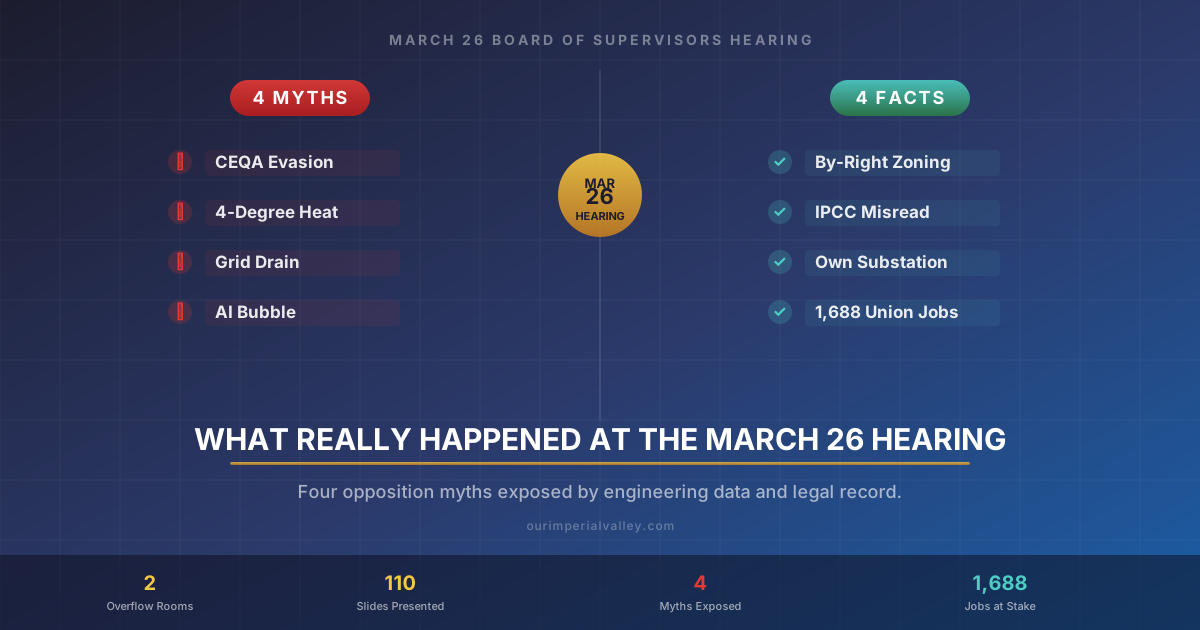
The room was full before the meeting officially started. On Thursday, March 26, 2026, at 6 PM, the Imperial County Board of Supervisors convened a special meeting to hear public comment on the Imperial Valley Data Center project — and the sheer volume of bodies overwhelmed every expectation. County officials scrambled to open two overflow rooms, including one at the County Public Health Training Center with a livestream. Even that was not enough. More than 50 residents were left standing in the parking lot, unable to get inside at all. "Not In My Backyard" signs bobbed above the crowd. "No Data Centers" chants echoed off the building walls before the first speaker even reached the microphone.
Inside, Sebastian Rucci delivered a 110-slide presentation spanning the project's engineering architecture, site plans, and commissioned impact studies. Outside, the opposition had already made up its mind. The hearing was deeply polarized — but polarization does not make both sides equal. One side brought engineering data, commissioned studies, and legal precedent. The other brought debunked climate models, unrelated utility disputes from 500 miles away, and demands to punish a project for following the law.
Here is a forensic fact-check of every major opposition claim made that night — and why none of them survive contact with the evidence.
The Four Claims Made — and Why They All Fall Apart
The opposition speakers at the March 26 hearing made four distinct factual claims against the IVDC project. Each one was presented with conviction. Each one collapses under scrutiny. What follows is not editorializing — it is a direct comparison of what was claimed versus what the engineering data, legal record, and publicly verifiable facts actually show.
Myth 1: "They're Evading CEQA"
Reina Adame and Jared Sanchez took the microphone and demanded the Board reject the project's ministerial classification, mandate a full discretionary CEQA review, and impose a moratorium on data center development. Adame dismissed Rucci's 110-slide engineering presentation as "arrogant posturing" and "smalltown drama." The implication was clear: the developers had found a loophole and were exploiting it to dodge environmental review.
The IVDC is evading CEQA by using a ministerial approval pathway. The Board should reject this classification and force a full discretionary environmental review. A moratorium should be imposed immediately.
The reality: The IVDC's 75-acre site at West Aten Road and Clark Road was already zoned I-2 (heavy industrial) before the developers ever arrived. Under California land-use law, when a project conforms to existing zoning, approval is ministerial — meaning the county applies a checklist of objective standards, not subjective judgment. This is not a loophole. It is the intended legal pathway. Judge L. Brooks Anderholt confirmed exactly this in his February 2026 court order, ruling that the County's CEQA exemption was "correct as a matter of law." Rucci himself acknowledged that his team selected I-2 land specifically to qualify for by-right permitting — that is compliance with the zoning code, not evasion of it. Demanding a discretionary review for a project that meets every objective criterion is demanding that the rules be changed after someone followed them.
Myth 2: "Data Centers Cause a 4°F Temperature Increase"
Jared Sanchez cited a study allegedly from Loudoun County, Virginia, claiming that data centers cause a 4-degree temperature increase in surrounding areas. This figure was presented as though it were a measured, localized effect of data center operations on nearby communities. The audience treated it as established fact.
Data centers cause a 4-degree temperature increase in surrounding areas, as demonstrated by data from Loudoun County, Virginia. The IVDC will cook Imperial Valley's already extreme desert heat.
The "4-degree" figure comes from the IPCC SSP5-8.5 global climate scenario — a macro-level worst-case projection for the year 2100. It refers to 4 degrees Celsius (not Fahrenheit) of global average warming under the most extreme emissions pathway. It is not a localized data center impact measurement. It has nothing to do with Loudoun County heat island effects. The IVDC uses advanced evaporative cooling, has reduced diesel generators by 85% (from 132 to 20), and deploys an 862 MWh zero-emission battery energy storage system (BESS) as its primary backup power — the opposite of the fossil-fuel-heavy profile implied by the opposition.
Myth 3: "The Grid Will Drain Like Lake Tahoe"
Shirley Mah delivered an impassioned warning about grid devastation, claiming that residents of Lake Tahoe were losing their power supplier because data centers were "soaking up all of Nevada's energy." The message was visceral: if it can happen there, it will happen here. The IVDC will drain Imperial Valley's grid the same way.
Data centers are draining Nevada's energy grid, causing Lake Tahoe residents to lose power. The IVDC will do the same to the Imperial Irrigation District grid, leaving local residents in the dark.
Liberty Utilities is an investor-owned utility (IOU) serving approximately 49,000 customers in the Lake Tahoe area. Its contract with NV Energy expires in May 2027 and is being replaced by the Greenlink Nevada transmission project — a planned infrastructure transition completely unrelated to data center demand. The IVDC is building its own private 330 MW substation. It operates on interruptible service, meaning IID can curtail or sever power to the facility at will during any grid emergency. The 862 MWh BESS can island the entire facility, instantly removing 330 MW of demand from the grid. The IVDC is a grid stabilizer, not a drain — it adds dispatchable load and battery capacity that strengthens grid resilience.
Myth 4: "AI Is a Bubble — Jobs Don't Matter"
Ian Hayasaka, identifying himself as an electrical engineering student, took a different angle entirely. He cited OpenAI's reported $16 billion operating loss as evidence that the AI industry is a speculative bubble, and dismissed the project's promised 100-200 permanent jobs as representing less than 1% of the region's unemployment. The subtext: why build infrastructure for an industry that might not exist in five years?
AI is a financial bubble. OpenAI is hemorrhaging money. The 100-200 permanent jobs are statistically insignificant. Building a $10 billion data center for an unstable industry is reckless.
The IVDC is a capital expenditure (CapEx) infrastructure project — physical real estate, servers, cooling systems, and fiber optic networks. These assets outlast software market volatility. Commercial property taxes are assessed on physical real estate value, not tenant software profitability. Whether OpenAI turns a profit or not, the $28.75 million per year in property taxes flows to Imperial County schools and public services regardless. Hayasaka made no mention of the 1,688 union construction jobs at $40-65/hour with benefits and pension. And critically: no opponent at the hearing offered a single alternative source for $28.75 million in annual revenue. Dismissing jobs as statistically insignificant is easy when you are not the one commuting hours daily to San Diego for work.
| Claim | Who Said It | What They Claimed | The Reality |
|---|---|---|---|
| CEQA Evasion | Reina Adame, Jared Sanchez | Project is dodging environmental review through ministerial loophole | I-2 zoning = ministerial by law. Court confirmed CEQA exemption correct. |
| 4°F Warming | Jared Sanchez | Data centers cause 4-degree local temperature increase | IPCC SSP5-8.5 global 2100 projection (4°C). Not localized measurement. |
| Grid Drain | Shirley Mah | IVDC will drain the grid like data centers drained Lake Tahoe's power | Liberty Utilities contract expiration unrelated. IVDC builds own substation, runs on interruptible service. |
| AI Bubble | Ian Hayasaka | AI is a bubble; 100-200 jobs are insignificant | CapEx infrastructure outlasts software volatility. $28.75M/yr in taxes flows regardless. 1,688 construction jobs ignored. |
The Voices That Mattered
Not every speaker that night came to obstruct. Some came to describe what the opposition's victory would actually cost them.
Jose Garcia, representing Laborers International Union of America Local 1184, spoke directly about what the data center means for working families. His testimony was not theoretical. Garcia described the extreme difficulty that union members face finding sustaining work anywhere within Imperial County — a region where double-digit unemployment has been the norm for decades, not the exception. Workers in his local commute hours daily to job sites in San Diego and Riverside counties, burning wages on gas and losing time with their families, because the Imperial Valley simply does not generate enough construction work to sustain them.
The IVDC represents 1,688 union construction jobs at prevailing wages of $40-65 per hour — with full benefits and pension contributions. For Local 1184 members, this is not an abstract policy debate. It is the difference between working in their own community and spending four hours a day on the road.
Garcia's testimony stood in stark contrast to the political theater that dominated the rest of the hearing. While Francisco Leal warned supervisors that the community would remember them "at the ballot box" — framing project approval as political suicide — Garcia reminded the room that the community also includes the workers who would actually build the thing. Leal's threat was about power. Garcia's testimony was about paychecks.
The opposition never answered the most basic question that Garcia's testimony raised: if you kill this project, where do those 1,688 jobs come from instead? No speaker offered an alternative employer. No speaker proposed a different source for $28.75 million in annual tax revenue. The opposition's plan for the Imperial Valley's economic future, stripped of the slogans and the chants, is silence.
The March 26 hearing was supposed to be a public forum. Instead, it became a case study in how misinformation scales when no one in the room is checking sources. A global climate model was presented as local temperature data. A Nevada utility contract expiration was repackaged as evidence of grid collapse. A software company's operating loss was conflated with physical infrastructure value. And a legally confirmed by-right project was described as though it were sneaking past the law.
Every one of these claims falls apart under basic scrutiny. The engineering data is public. The court rulings are on record. The zoning code is not ambiguous. The question facing Imperial County is not whether these myths are true — they are demonstrably not. The question is whether the Board of Supervisors will govern based on verifiable facts, or yield to a crowd that showed up with slogans instead of data.
The 1,688 workers who would build this project — and the families who depend on them — deserve an answer grounded in evidence, not applause lines.
Sources: Imperial County Board of Supervisors Special Meeting, March 26, 2026; IVDC 110-slide engineering presentation (Sebastian Rucci); IPCC Sixth Assessment Report, SSP5-8.5 scenario; Liberty Utilities NV Energy contract filings; Greenlink Nevada transmission project documentation; Imperial County Superior Court Order (Case No. ECU004457, filed 02/27/2026); Imperial County Zoning Ordinance, I-2 Heavy Industrial classification; Laborers International Union of America Local 1184 public testimony; IVDC project economic impact data (property tax, employment projections).