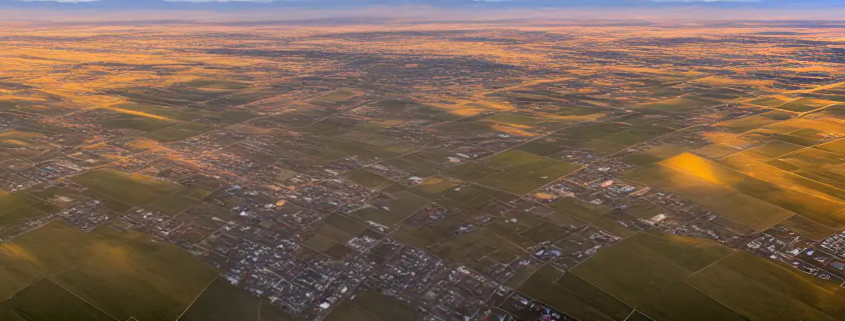

Imperial Valley’s identity is agricultural. The alfalfa, the vegetables, the cattle — grown in a desert made productive by the engineering marvel of the All-American Canal — are the foundation of a regional economy that has sustained families and communities for generations. The farmworker tradition, the irrigation districts, the processing and logistics infrastructure that moves the Valley’s produce to markets across the continent — these are not relics. They are active economic systems supporting real people.

They are also a foundation, not a ceiling. The same geography that made the Valley ideal for irrigated agriculture — abundant sunlight, geothermal energy beneath the surface, available land — makes it ideal for the technologies of the next economic cycle. The transition from an economy built exclusively on agriculture to one that integrates clean energy, critical minerals, and technology infrastructure is not a departure from the Valley’s identity. It is the next chapter of a community that has always succeeded by working with what the land provides.

What Economic Diversification Actually Requires

Economists who study the long-term trajectory of resource-dependent regions consistently identify diversification as the key variable separating communities that sustain themselves through multiple economic cycles from those that decline when their primary industry contracts. The agricultural economy of Imperial Valley is not in crisis — but the structural pressures on water allocation, on the agricultural labor market, and on the commodity pricing that determines farm profitability are real and long-term.

Diversification into clean energy and technology infrastructure addresses these pressures by adding economic sectors that are not correlated with agricultural commodity prices or water availability in the same way that farming is. A data center that employs engineers and technicians, generates $28 million in annual property tax, and provides a stable industrial electricity customer for IID is adding economic diversity that reduces the Valley’s vulnerability to shocks in any single sector.

This is not a novel analysis. It is the standard framework for regional economic resilience planning. What is unusual about Imperial Valley’s situation is the scale and quality of the specific diversification opportunity that the IVDC represents — and the extraordinary extent to which coordinated opposition has worked to prevent the community from capturing it.

The Transition Generation

The workers who would fill the 1,688 union construction positions attached to the IVDC are, in many cases, the children and grandchildren of farmworkers. They grew up in the Valley. They have watched the employment opportunities available to them stay relatively flat while opportunities in neighboring regions have expanded. Many have left for better prospects elsewhere. Many who stayed are working in conditions that are challenging even in good years.

The construction trades offer a specific kind of economic mobility that the agricultural economy, for all its real value, has not consistently provided: union wages, benefits, apprenticeship programs, and the portable credentials that allow a skilled tradesperson to build a career regardless of whether the local economy has a specific project underway at any given moment. An IBEW electrician trained on the IVDC build is an IBEW electrician with credentials that have value across the entire West Coast construction economy.

The transition from agricultural to diversified economy is not a betrayal of the Valley’s working-class roots. It is the fulfillment of the aspiration that those roots represent: that the work of a generation builds something better for the next one. The IVDC is one piece of that fulfillment. Getting it built is how the aspiration becomes real.


The economic potential of Imperial Valley has been recognized and discussed for years. The geothermal resources. The lithium in the Salton Sea brine. The solar irradiance. The land. The independent grid. Academic papers have been written, government reports commissioned, investment conferences held. The Valley is consistently described as one of the most significant untapped economic development opportunities in the American West.

And yet the transformation keeps not quite arriving. CTR is fighting through CEQA challenges. The IVDC is fighting through litigation. Other projects in the pipeline face similar obstacles. The gap between the Valley’s recognized potential and its realized economic development is large and persistent.

That gap has a cause. It is not geological, it is not infrastructural, and it is not financial. It is political and institutional. The same patterns that are documented in the IVDC fight — organized CEQA obstruction, coordinated opposition by officials and organizations with competing interests, manufactured legal exposure — appear across multiple projects in the region. The Valley keeps almost capturing its economic future because certain actors benefit from the capture never completing.

What a Realized Lithium Valley Requires

Lithium Valley — the geothermal lithium extraction opportunity in the Salton Sea region — is a national strategic priority. Domestic lithium supply for electric vehicle batteries and grid storage is a critical minerals challenge that affects the United States’ ability to transition its energy system and reduce dependence on Chinese supply chains. Imperial Valley is the most significant domestic opportunity for addressing that challenge.

Realizing that opportunity requires multiple large projects getting built in a reasonable timeframe. CTR and its competitors have invested years and significant capital in development. They have navigated federal, state, and local approval processes. They are capable of building these projects. What they need is an institutional environment that allows permitted projects to proceed — without the greenmail demands, the coordinated CEQA campaigns, and the jurisdictional overreach that have characterized the Imperial Valley development environment.

The IVDC fight is connected to the Lithium Valley fight because the same institutional environment affects both. A region that demonstrates — through the IVDC outcome — that permitted projects can be completed despite organized obstruction sends a different signal to every Lithium Valley developer than a region that demonstrates the opposite.

The Data Center as Infrastructure for Everything Else

The IVDC is not just a data center. It is demand-side infrastructure for the energy economy that the Valley is trying to build. A 330-megawatt industrial customer for IID creates the load that justifies additional generation investment. Additional generation investment makes more geothermal projects financially viable. More geothermal projects bring more lithium extraction. Lithium extraction brings battery manufacturing interest. Battery manufacturing brings the entire value chain of the clean energy transition to a region that has the resources to anchor it.

None of this happens if the first major step — a hyperscale data center on industrial land with access to geothermal power — gets blocked by organized obstruction after clearing every legal hurdle. The IVDC is the anchor tenant of an economic ecosystem that doesn’t exist yet but could. The fight over whether it gets built is a fight over whether that ecosystem ever starts to form.

Imperial Valley has been on the verge of transformation for too long. The people who live there are entitled to see that transformation actually happen, and to hold accountable the actors who have made it their business to prevent it.

Counties don’t get many chances like this. A single construction project generates $72.5 million in one-time sales tax revenue — before the first server rack is installed, before the first employee badge is printed, before the first year of $28.75 million in recurring property tax is collected. Just from buying the steel, the concrete, the electrical infrastructure, and the cooling systems that a 950,000-square-foot data center campus requires.

For context: Imperial County’s entire annual general fund budget runs around $600 million, and a significant portion of that is state and federal pass-through funding the county does not control. A $72.5 million capital injection — money that the county can actually direct — is not a budget line item. It is a generational financial event.

What a County Can Do With $72 Million

Deferred infrastructure maintenance is the quiet crisis that every Imperial County department director knows and few outside observers understand. Roads that should have been repaved five years ago. Bridges that are flagged but not fixed. County buildings that are heated and cooled by systems installed in the Reagan administration. The maintenance backlog grows every year because the general fund is perpetually stretched between competing urgent needs and the capital projects keep getting deferred.

Seventy-two million dollars — applied strategically to the county’s infrastructure backlog — would not solve every problem. But it would make a dent that no other single source of funding currently on the table comes close to matching. Bond measures require voter approval and debt service. State infrastructure grants are competitive and conditional. Federal funds arrive with compliance requirements that consume significant administrative capacity.

A one-time sales tax payment requires none of those conditions. It arrives when the equipment is purchased. The county spends it according to its own priorities.

The Alternative Is Not Neutral

There is a common rhetorical move in the opposition’s argument that deserves examination: the implicit suggestion that blocking the project is a neutral act — that the county simply returns to its baseline if the data center doesn’t come. That framing is false.

The baseline is not neutral. The baseline is the infrastructure maintenance that doesn’t happen, the school repair that gets deferred another year, the reserve fund that doesn’t exist when the next fiscal emergency arrives. The $72.5 million is not a speculative future benefit. It is a concrete, calculable loss that accrues to the county’s public infrastructure every year the project is delayed or blocked.

The people making the argument for delay are not the ones who will drive across the potholes, teach in the aging classrooms, or manage the deferred maintenance on a county budget that never quite has enough. They have made a comfortable calculation that the costs of their opposition will fall on someone else.

This Money Would Come From the Developer, Not Residents

Sales tax on construction materials and equipment is not paid by Imperial County residents. It is paid by the developer — in this case, a $10 billion project purchasing hundreds of millions of dollars in equipment, much of it subject to California sales tax. The county collects revenue that was generated by a private party’s investment decision, without imposing any additional burden on the households and small businesses already contributing to the local tax base.

The opposition has not explained how refusing this revenue serves the public interest. They have not identified an alternative source. They have filed lawsuits, introduced legislation, and organized campaigns — all of which cost money that ultimately comes from somewhere — while the $72.5 million waits on the other side of a building permit.

At some point, the question is not whether this project is good for Imperial County. The question is who benefits from preventing it.

There is a question that every economic development official in a chronically underinvested region eventually confronts: when the investment finally comes, will the institutions that are supposed to welcome it actually do so?

Imperial County is confronting that question right now. The Imperial Valley Data Center represents a $10 billion capital commitment to a 75-acre industrial site in one of the most economically distressed counties in California. No private entity in the county’s history has made a comparable investment commitment. Not the agricultural processors, not the energy companies, not the logistics firms that have come and gone over the decades. Ten billion dollars, on land that is zoned for exactly this use, approved through the county’s legitimate ministerial process.

And some of the region’s own officials are litigating to stop it.

Scale in Context

It is worth sitting with what $10 billion means in a county the size of Imperial. The county’s total assessed value — the cumulative value of all property, commercial and residential, within its borders — is measured in the tens of billions. A single private investment of $10 billion doesn’t just add to that base; it restructures it. The ratio of commercial to residential assessed value shifts. The county’s credit position improves. The ability to finance future infrastructure improvements — schools, roads, water systems — expands because the collateral base supporting those instruments is materially stronger.

This is before a single permanent employee is hired, before a single server is powered on, before the recurring $28.75 million in annual property tax begins flowing to county services.

What the Multiplier Looks Like on the Ground

Economic multipliers are often cited as justification for subsidizing private investment. In this case, no subsidy is being requested — the developer is paying full cost for permits, infrastructure improvements, and utility connections. The multiplier effect flows entirely to the county.

During the multi-year construction phase, 1,688 union workers drawing prevailing wages will spend money in Imperial County. They will rent housing, buy groceries, eat at restaurants, purchase work supplies, and use local services. The businesses that serve them will hire additional staff. The hotels and rental properties that house out-of-region workers will generate occupancy tax. The contractors and subcontractors who supply materials and services will place orders with local vendors wherever possible.

Economic research consistently finds that major construction projects generate two to three indirect and induced jobs for every direct construction position. Applied to 1,688 direct positions, that implies a total employment impact of four to five thousand jobs during the build phase — in a county where the working-age population is roughly 100,000 people.

The Infrastructure That Comes With It

The project includes a dedicated 330-megawatt substation — infrastructure that the developer is paying for, not the county, not IID ratepayers. The wastewater recycling upgrades the developer proposed for municipal plants in El Centro and Imperial would have improved those utilities’ infrastructure at private expense. The 862 megawatt-hour battery storage system would add grid stabilization capacity to the IID service territory, benefiting ratepayers who would otherwise pay for those stabilization services through utility rates.

These are not ancillary benefits. They are the kind of private-funded public infrastructure improvements that counties typically spend decades trying to attract through tax incentives, grant competitions, and development agreements. They are being offered as part of the standard project package — and the opposition is fighting to refuse them.

The Institutional Question

When a region consistently fails to convert economic development opportunities into actual investment, it eventually stops attracting them. Site selectors and developers maintain institutional memory. A county that fights a $10 billion by-right project through years of litigation sends a signal to the next developer evaluating a site list that includes Imperial County: find somewhere else.

The officials litigating against this project will not be held responsible for the investments that don’t come next. The residents who depend on the jobs and tax revenues those investments would have generated will bear that cost invisibly — in the school that stays underfunded, the fire station that stays understaffed, the young adult who moves away because there isn’t enough work to stay.

Imperial County has one chance to get this right. The courts have agreed the project is legal. The land has been zoned for this use for decades. The investment is ready. The decision now is whether the county’s institutions will honor the choices that brought it here.

Silicon Valley is full. The land is expensive, the power grid is constrained, and the water is scarce. The hyperscale data centers that train AI models and process the world’s information can’t be built there at any price that makes economic sense. So the industry moved — to eastern Washington, rural Iowa, West Texas, northern Virginia — to places that have abundant land, access to power, and room to build at scale.

Imperial Valley has all of those things. It also has something most of those competing locations don’t: a geothermal energy resource that can power next-generation AI infrastructure with zero-carbon electricity, and a local workforce that needs the jobs badly enough that you don’t have to offer equity packages to fill construction crews.

The question is not whether the Imperial Valley Data Center is a good fit for this region. The question is whether this region will make the institutional choices necessary to capture the opportunity.

The National Pattern

Microsoft’s data center campus in Quincy, Washington transformed a small agricultural community into one of the most significant technology infrastructure hubs in the world. Google’s data centers in rural Iowa have generated hundreds of millions of dollars in local tax revenue and created thousands of construction and operational jobs in counties that had no realistic alternative economic development path. Meta’s facility in Prineville, Oregon became the economic anchor of a community that had watched its timber industry collapse.

In each of these cases, the pattern was similar: a region with cheap land, reliable power, and a workforce hungry for industrial-wage employment received a major technology infrastructure investment that restructured its local economy. The counties that said yes to these projects — and fought for them against the inevitable opposition — transformed their fiscal positions, their school systems, and their residents’ economic prospects.

The counties that said no, or whose institutional resistance made approval too costly and slow, are still waiting for the next opportunity. Some are still waiting.

What Imperial Valley Has That Others Don’t

Imperial Valley’s energy infrastructure is unusual. The Imperial Irrigation District operates an independent grid — not subject to CAISO transmission constraints, not dependent on the same overloaded southern California infrastructure that limits development in coastal communities. IID has generation capacity and the ability to accommodate major new industrial loads in ways that grid-dependent utilities cannot.

The region sits on one of the world’s most significant geothermal resources. The same Salton Sea brine that carries the lithium that Lithium Valley developers are racing to extract also carries thermal energy that can generate baseload renewable electricity at industrial scale. A data center campus co-located with geothermal generation creates a vertically integrated energy-compute stack that no coastal California location can replicate at any cost.

Add the I-2 heavy industrial zoning that makes the specific IVDC site legally available by right — without the discretionary reviews and community approval processes that add years and tens of millions to comparable projects in other jurisdictions — and the case for Imperial Valley as a premier data center location is not just plausible. It is compelling.

The Cost of Saying No

Rural communities that block major industrial investment don’t return to a neutral baseline. They return to a trajectory of gradual fiscal deterioration, population loss, and declining public services. The young people who leave for better opportunities don’t come back. The businesses that serve a working population contract. The tax base erodes, which reduces services, which accelerates outmigration, which further erodes the tax base.

This is not speculation. It is the documented history of dozens of rural California communities that didn’t diversify their economic base before their primary industry contracted. Imperial Valley has managed to sustain itself on agriculture longer than many comparable regions, but the structural pressures are identical.

The IVDC is not the only economic development opportunity the Valley will ever see. But it is the largest one currently on the table, and it has already cleared the most significant legal and regulatory hurdles. The people organizing to block it have not identified what they think should come instead. That is a significant omission, and the residents who would benefit from the project deserve to ask for an answer.